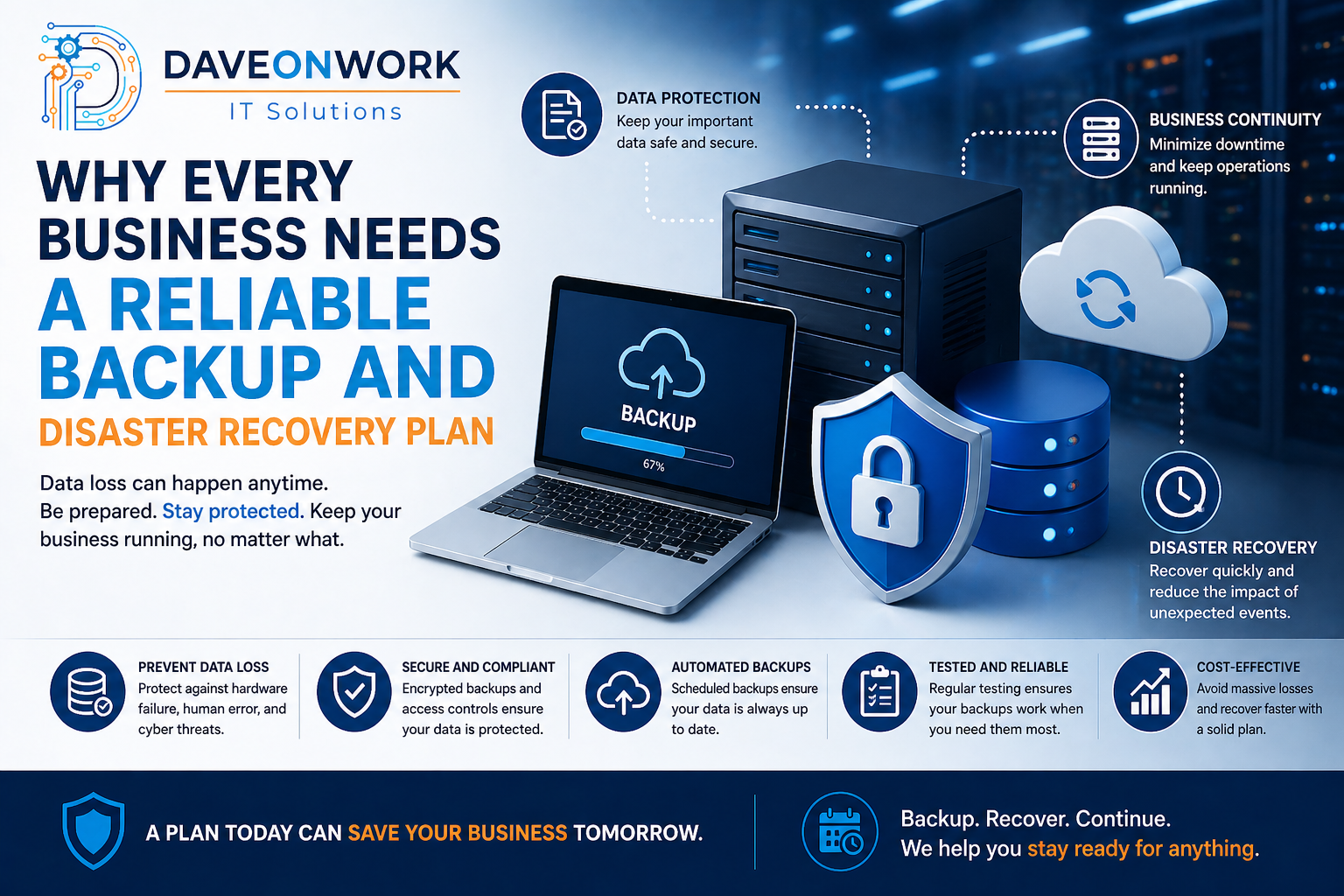
Why Every Business Needs a Reliable Backup and Disaster Recovery Plan
In today’s digital-first environment, data is one of the most valuable assets of any business. From customer records to financial transactions and operational systems, losing data can result in serious disruptions, financial loss, and reputational damage.
Yet many organizations still underestimate the importance of having a reliable backup and disaster recovery (DR) plan—until it’s too late.
This article explains why backup and disaster recovery are critical and how businesses can implement them effectively.
1. Data Loss Happens More Often Than You Think
Data loss is not limited to cyberattacks. It can happen due to:
• Hardware failure (e.g., damaged SSD or server crash)
• Human error (accidental deletion)
• Malware or ransomware attacks
• Power interruptions or system corruption
Key takeaway:
If your data exists in only one place, it is always at risk.
2. Backups Are Your First Line of Defense
A backup ensures that even if your system fails, your data is not permanently lost.
Best practices:
• Follow the 3-2-1 backup rule
• 3 copies of data
• 2 different storage types
• 1 offsite backup
• Automate backup processes
• Encrypt sensitive data
3. Disaster Recovery Ensures Business Continuity
Backup alone is not enough—you also need a plan to restore operations quickly.
A Disaster Recovery (DR) plan defines:
• How systems will be restored
• Who is responsible
• How long recovery should take
Important metrics:
• RTO (Recovery Time Objective) – How fast you recover
• RPO (Recovery Point Objective) – How much data you can afford to lose
4. Downtime is Expensive
Even a few hours of downtime can cost businesses:
• Lost revenue
• Operational delays
• Customer dissatisfaction
• Compliance risks
Reality:
Prevention and preparation are always cheaper than recovery.
5. Backups Must Be Tested Regularly
Many businesses have backups—but never test them.
What to do:
• Perform regular restore testing
• Validate backup integrity
• Simulate failure scenarios
6. Cloud and Hybrid Solutions Improve Reliability
Modern backup strategies use a combination of:
• Local backups (fast recovery)
• Cloud backups (offsite protection)
This hybrid approach ensures both speed and resilience.
7. Security Should Be Integrated
Backup systems must also be secured to prevent tampering or ransomware attacks.
Ensure:
• Access control and authentication
• Backup encryption
• Immutable or versioned backups
Recommended Backup & DR Setup for SMEs
A practical setup for most businesses includes:
• Automated daily backups (local + cloud)
• Weekly full backup + incremental backups
• Offsite/cloud storage (AWS, Google Cloud, or similar)
• Documented DR plan with assigned roles
• Quarterly testing and validation
Final Thoughts
A backup and disaster recovery plan is not optional—it is a critical part of your IT strategy.
Without it, your business is exposed to risks that can halt operations in an instant.
With it, you gain:
• Peace of mind
• Business continuity
• Data protection
• Operational resilience
Investing in backup and disaster recovery is not just about protecting data—it’s about protecting your entire business.